Wednesday, November 2, 2011

Beowulf response

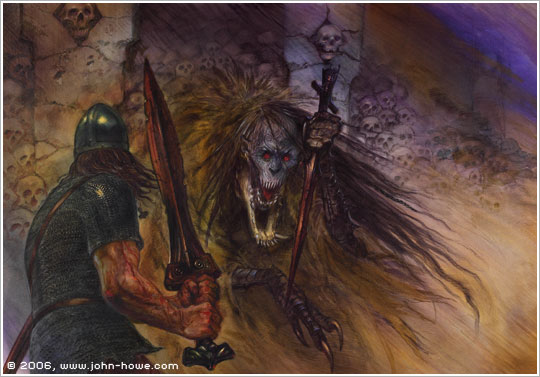
As Jake states in his blog http://lwithforce.blogspot.com/2011/10/beowulf.html Beowulf is unlike any other story we have read so far.  There are heavy supernatural occurrences yet there is really no intervention from the gods.  People are fighting monsters but other than that the world seems to be grounded in reality.  It is odd to have a seemingly normal world with monster running around but that is what is happening in the story.

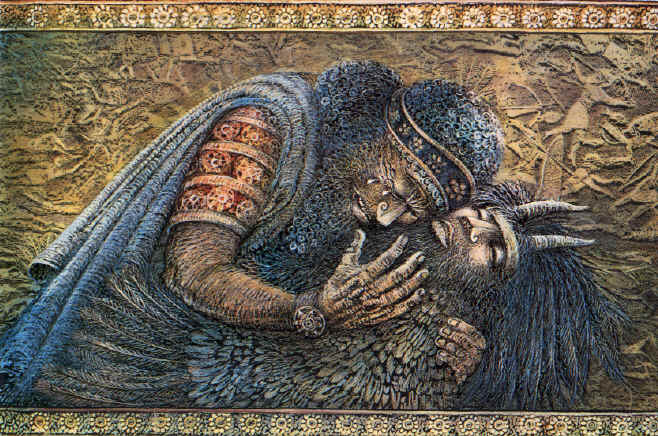
Jake also draws connections between Beowulf and Gilgamesh.  I agree with this because both stories revolve around two leaders who go out and kill monsters.  There man difference is Beowulf is a better leader.  His people and fellow warriors love him.  His acts of courage inspire people and he even gave his life to save his people.  Gilgamesh really quested for his own personal glory.  His big quest was for eternal life Beowulf’s was to save his land.  I agree with jakes post on all the points he made.

Thursday, October 27, 2011

Was Beowulf crazy?

Beowulf was a warrior.  He also liked to jump into any challenge.  He had a lot of pride but it could have been something more.  His lust for battle and glory could have steamed from a deeper problem.  The man was nuts.  He seems to have very strong self-destructive tendencies.  Either he is the world’s bravest man or just plain crazy.

In his fight against Grendel he wanted to defeat him using nothing but his grip.  He grappled with him and used his strength to rip off Grendel’s arm.  He went into the battle planning to defeat him using only his manly strength.  He did not even have a plan of attack.  He just winged it.  Grendel was a monster known for his power, and he wanted to test his skills in battle.

He also goes to fight Grendel’s mother with no course of action.  She is the mother of a monster.  Feared across the land and he has no plan.  Just runs in and dose whatever comes to mind.  To him his death will be his and if he is defeated then so be it.  He really does not seem to care if he dies in battle.  He just wants the challenge.

He swam the ocean holding a sword just in case he needed it.  It is bad enough he swam into the middle of the ocean, but he had to do it holding a large sword.  He could not have even strapped it to his back he had to carry it with him in his hand.  That just seems like a bad decision to a normal person.

To wrap it up he is either very brave or just mad.  Someone who was not mad would have thought things out better.  He just ran into every change without a care in the world.  I could be reading too much into this but he just does not seem all there to me.

Tuesday, October 11, 2011

The Tragic Hero

The tragic hero is a something popularized in Greek tragedies.  But what if the Greeks where not the first with this idea of the tragic hero?  In the epic of Gilgamesh the main character Gilgamesh is in fact a tragic hero.  He shares many characteristic with the Greek tragic hero and in fact he shares similarities with Creon from Antigone.

This concept of hubris is “excessive pride or self-confidence; arrogance.” According to dictionary.com. This is a major character flaw in both of these Hero’s.  Creon said “You’ll never bury that body in the grave, not even if Zeus’s eagles rip the corpse and wing their rotten picking off to the throne of God!”  This is such a prime example of hubris. 

In the Epic of Gilgamesh, Gilgamesh’s pride is the thing that kills him.  He is self-destructive and he really does not get it until the end.  To me he is a prime example of what it means to be a tragic hero.

I want to argue that Gilgamesh is the first recorded tragic hero in literature.  I will break down what it means to be a tragic hero, and compare these to the Greek tragic hero’s to Gilgamesh. 

Tuesday, October 4, 2011

Antigone

Antigone is a tragic play.  There are some key elements that make this a tragedy.  Also there are two possible candidates for being a tragic hero in the story, but one to me stood out more as the true tragic hero. 

There are many different tragic elements in this story.  First of death is a common theme in the story.  Antigone’s brothers die, and so does she.   Creon also losses his son and then his wife.  “I killed you, I, god help me, I admit it all!”  Another big thing is that most of the death could have been avoided but the characters where to flawed to do so.  The main characters had flaws and that is big in Greek tragedy's.  also the tone of the story was grim witch is a common theme also.
I personally feel that Creon is the true tragic hero of this story.  Antigone did voluntarily do something knowing it could end up killing her.  She had to bury her brother even though her sister warned her about the outcome. She never really had a revelation or a turning point she just maintained her same level or spirit through out the story.  “You chose to live, I chose to die.”  She comes to a tragic ending and had her fatal flaws, but she is not the tragic hero. 

Creon not only dooms himself but he dooms his family with his arrogance and pride.  It is because of this he is the tragic hero of the story.  “You’ll never bury that body in the grave, not even if Zeus’s eagles rip the corpse and wing their rotten picking off to the throne of God!”  It is this pride that his down fall.  His own son came to him to ask him just to spare her.  He could not do so and because of that everything in his life went to hell.  His character finally wants to set things right, but by the time he dose it is all too late and he cannot bring back his loved ones for his own pride killed them.


Thursday, September 29, 2011

The Bible and Me

For me this was my first time reading any biblical stories.  I have only heard of them from various places, but I never took the time until now to read any of them.  I used to feel like they would not be relevant to me at all.  After reading some of it one quick relies that there is a lot to take away from those stories and they can see the importance of it.

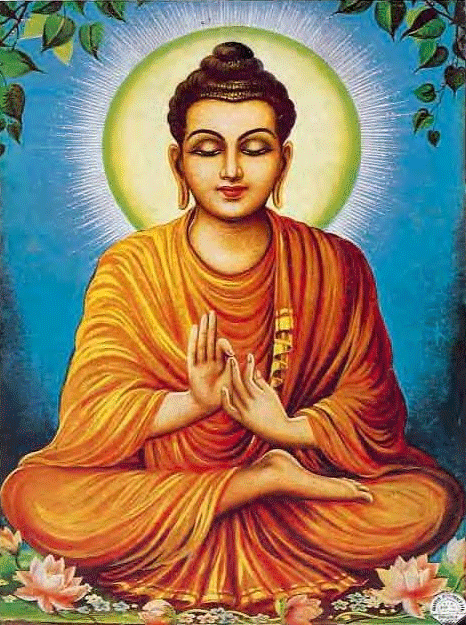
Last year I became a Buddhist and part of Buddhism is being excepting of other religions.  Before being Buddhist I was atheist and a bit of a dick about it.  I never grew up with a set religion when I was younger so I never got the point of religion.  I did see the point of it, and how it can help people.  I only saw the pole on T.V quoting it.

The bible has a lot to offer to people of any faith.  It just gets a bad rap because some people use it to push their own views on others.  Taking quotes from it and use it to try to justify their own views.  From what I read of it and I understand now it’s not meant to be taken literally it is a guide not an instruction manual.  It is meant to show you examples of positive ways to live your life and that is what I take it as. 

I probably would not have read any of it if it was not for this English class, but it was a worthwhile experience.  If only to just get a better understanding of what the Bible is about.  I found things I can take away from it and feel better informed because of it.

Tuesday, September 27, 2011

Homer vs Biblical Authors

Auerbach compared Homers writing to that of biblical writers.  He was comparing the literature to see who the better writer was.  He claimed that “Homer can be analyzed . . . but he cannot be interpreted”.  To understand that we must know what those words mean.
Analyzed- To separate (a material or abstract entity) into constituent parts or elements; determine the elements or essential features.
Interpretation - An explanation of the meaning of another's artistic or creative work.
Now given these definitions from Dictionary.com I would have to agree with Aurback.  Homer spells everything out in his writing. No stone goes unturned and nothing is leaven to the imagination.  “His mother’s father-a great thief and swindler” Homer even has to explain the back story of people who just make an appearance in a flashback.  There is nothing left to interpret because he holds our hand and tells us everything we need to know.  All we have to do is analyze it by looking at all the pieces in the writing.
The biblical writers took a different approach to this.  In Abraham and Isaac it says “Behold, here I am”.  That was god talking to Abraham, and we are given no context to where god is or even if he is in a physical or astral form.  “and they came to the place which God had told him of,”  again in this it is just a vague place that we do not know about.  We can interpret the bible and analyze it.  People can fill in the blanks and find meaning in it because everything is not feed to us.  People can take away different meaning from it because we interpret it and that is something we all do differently.

Auerbach felt that the biblical authors did a better job than Homer did.  Homer had to explain everyone motivation and everything that happened.  The biblical writers did not have to explain everything in their stories.  They left things up to interpretation.  Homers stories are entertaining but that is all they are.  The biblical stories are meant to teach us and make us think.

Thursday, September 22, 2011

Enkidu

Enkidu is a character that is interesting to me.  He starts off innocent and at one with nature.  Then he becomes that of a civilized man.  Then he goes off and becomes an adventurer.  He dose through these phases so fast his character is very dynamic compared to everyone ells in the story.
“Enkidu ate grass in the hills with the gazelles” That says allot about his purity.  He just hung out with the animals and they accepted him for he was pure of heart.  He had no ill intent or malice in his heart.  He acted on instinct and was more beat than man.

That all changed when he lay with the harlot.   “When the gazelle saw him, they bolted away” He was rejected by the animals after he had embraced the women.   After he had no place left to go she showed him how to become a proper man.  She took him back to her temple and clothed him.  She fed him, and turned him into a real man.

After he met Gilgamesh they became good friends.  They went on adventures and relied on each other for they were two half’s of the same coin.  Enkidu even helped slay the bull of heaven he ‘seized it by the horns”.  The bull charged him and knocked him over so he gets up and restrains it by himself so Gilgamesh can kill it.  That is not something he would have done if he was still a feral man.

Enkidu to me was a really interesting character and noteworthy.  He was such a dynamic character in a story filled with static one.  When he died for me the story was less interesting because I did not really care about Gilgamesh.